


Achieving the smile you’ve always wanted is an important decision that goes beyond aesthetics; it’s about your health and self-confidence. In 2026, the demand for orthodontic treatment continues to grow, showing that it’s never too late to improve the alignment of your teeth. Whether for a growing child, an adolescent or an adult with a busy professional life, there are now options to suit every lifestyle and budget.
What is orthodontics and why is it necessary?
We often think orthodontics is only for “straightening” teeth, but its role goes much deeper. This speciality is responsible for diagnosing and correcting problems with your bite and the position of your teeth.
If you feel your teeth are “crowded”, there are visible gaps between them (diastemas), or you notice your upper and lower teeth don’t fit together properly when you close your mouth, orthodontics is the definitive solution. Correcting these issues not only improves your appearance, but also makes daily cleaning easier and prevents premature wear on your teeth.
How do braces work?
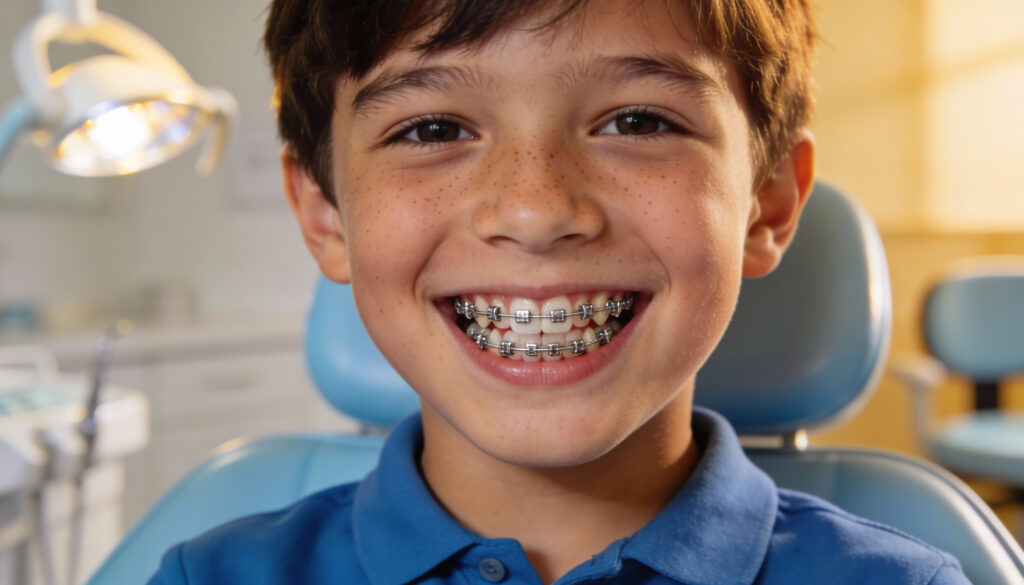
Although it may seem like magic, the process is pure science. Braces are small pieces bonded to each tooth that act as “guides”. A wire (a metal arch) is threaded through them and applies a gentle, light and constant force. This pressure stimulates the bone so the teeth gradually move towards their ideal position. Treatment is usually divided into phases: first the teeth are aligned, then the bite is corrected and finally any remaining spaces are closed.
Types of braces: Which is ideal for you?
Nowadays, we have various technologies to make the process as comfortable and discreet as possible:
1. Metal braces: The classics that never fail
They remain the most widely used system thanks to their great effectiveness and track record.
- Advantages: They are extremely durable and allow very precise control of movement, even in difficult cases. In addition, they are usually the most economical option.
- Who they’re for: Ideal for children and adolescents because of their durability against knocks or hard foods.
2. Aesthetic braces (Ceramic and sapphire): Discretion above all
If you’re concerned about them being noticeable, this is your option. They are made from materials that mimic the tooth colour (ceramic) or that are completely transparent (sapphire).
- Advantages: They are much more discreet when you smile, which encourages many adults to start treatment.
- Considerations: They tend to cost a little more and require a bit more care with hygiene so the ligatures don’t stain with certain foods.
3. Lingual braces: The “truly” invisible orthodontic option
Unlike the others, these are placed on the inner surface of the teeth.
- Advantages: They are completely invisible from the outside. No one will know you are wearing them, not even at close range.
- Who they’re for: Professionals who work face-to-face with the public or people with the highest aesthetic demands.
4. Self-ligating braces: Comfort and speed
This system uses a special clip to hold the arch in place without the need for “rubber ties” or traditional ligatures.
- Advantages: By reducing friction, movements can be smoother and dentist visits are often quicker and more spaced out. Also, without elastics they trap less food debris.
How long does the treatment last?
Although every mouth is unique, the average duration typically ranges between 18 and 24 months. The simplest cases can be resolved in a year, while the most complex may take longer. Factors such as your age, the complexity of your case and, above all, your cooperation with hygiene and appointments are key to finishing on time.
Braces vs. Aligners (Invisalign)
It’s the million‑dollar question. While braces are fixed and don’t rely on you remembering to wear them, clear aligners are removable. Braces tend to be more effective in very severe cases and usually have a lower cost. On the other hand, aligners offer superior comfort as they can be removed for eating and toothbrushing.
The future is here: 2026 technology
Today the process is much more predictable thanks to 3D digital planning. With an intraoral scanner, we can simulate how your smile will look before starting. In addition, new heat‑activated archwires adapt to your mouth’s temperature to move the teeth more efficiently and with less discomfort.
Are you ready to take the first step? The best time to start caring for your smile is now. an assessment appointment will allow you to find out which type of braces best suits your needs and how you can transform your dental health in less time than you might imagine
Leave a Reply